How Digital Health Tracking Is Changing Preventive Wellness Planning
More than one in three American adults now wear a health-tracking device daily, according to data from the Pew Research Center. That number has more than doubled over the past decade, and it reflects a clear shift in how people are approaching their own health. Instead of waiting for symptoms to appear before seeing a doctor, millions of people are now monitoring their bodies in real time, using devices and apps to stay ahead of potential problems.
This movement toward continuous, data-driven self-monitoring is reshaping what preventive care looks like. Resources focused on hormone optimization and healthspan planning represent a growing category of physician-guided preventive strategies that incorporate this kind of data to build more personalized, long-term wellness plans. The question worth asking is where everyday consumer tracking ends and medically meaningful preventive care begins.
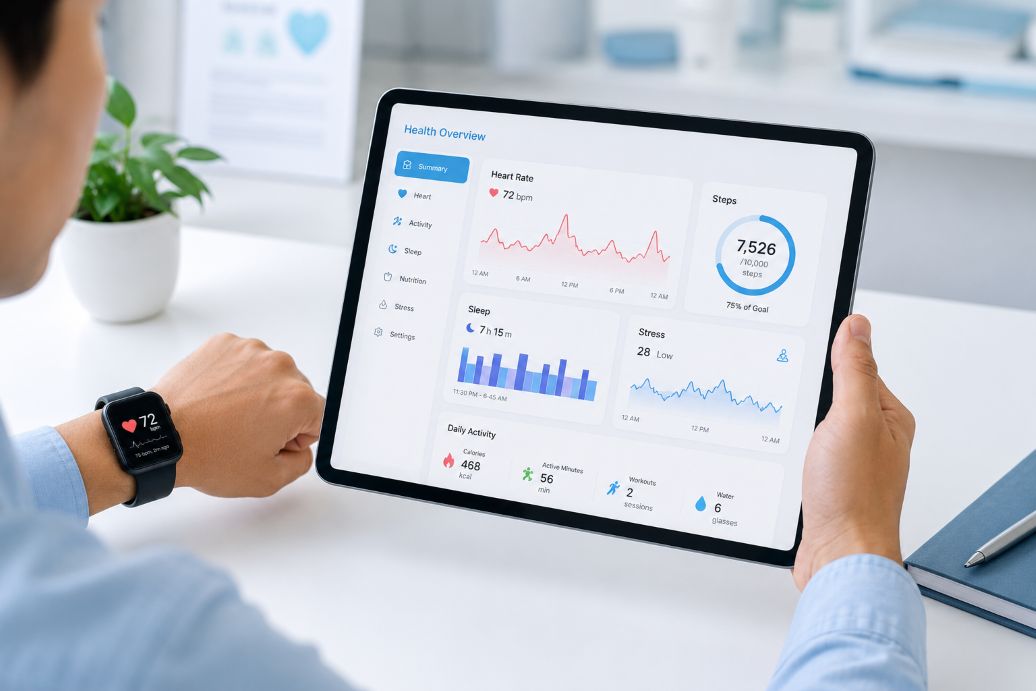
The Rise of Wearables, Remote Monitoring, and Health Apps
The market for digital health tools has grown at a remarkable pace. Grand View Research estimates the global wearable medical device market was valued at over $27 billion in 2023, with projections pointing to continued expansion through the end of the decade. Fitness trackers, smartwatches, continuous glucose monitors, sleep trackers, and heart rhythm sensors are now widely available and affordable for most consumers.
Remote patient monitoring has also grown significantly beyond hospital settings. Platforms like those developed by Withings and Dexcom allow users to track everything from blood oxygen saturation to blood glucose trends, transmitting data to both the user and, in some cases, their healthcare provider. Health apps add another layer, helping users log meals, track menstrual cycles, monitor stress patterns through heart rate variability, and chart their sleep architecture night by night.
The American Heart Association has noted that consumer-grade wearables can help people detect irregular heart rhythms, which has led to earlier diagnosis of conditions like atrial fibrillation in some cases. That is a meaningful outcome. Still, the capabilities of these tools vary widely, and the gap between tracking data and understanding what it means remains significant for most users.
General Wellness Tracking vs. Physician-Supervised Preventive Care
Consumer health tracking and physician-supervised preventive care serve different purposes, and they operate with very different levels of precision and accountability. Understanding both helps clarify what each can realistically deliver.
General wellness tracking is accessible, continuous, and motivating for many users. Seeing step counts, sleep scores, and heart rate trends every morning can encourage healthier habits. Research published in JAMA Internal Medicine found that wearable activity trackers modestly but consistently increased physical activity levels among users over time. That is not trivial. Sustained increases in daily movement are associated with reduced risk of cardiovascular disease, type 2 diabetes, and several cancers.
However, consumer devices come with real limitations. Most are not FDA-cleared for clinical diagnostics. Algorithms vary between brands, data can be inconsistent, and without clinical context, a flagged metric can cause unnecessary anxiety or, worse, be dismissed when it actually signals something worth investigating. The Food and Drug Administration has repeatedly noted that wellness devices and medical devices are held to different regulatory standards, and consumers do not always understand that distinction.
Physician-supervised preventive care takes a fundamentally different approach. It begins with a thorough clinical evaluation, relevant lab work, and a review of personal and family history. From there, a physician can design a plan that targets measurable biological markers rather than generic wellness scores. This might include monitoring inflammatory markers, metabolic panels, lipid profiles, or hormone levels across time. The goal is not just to feel better in the short term but to identify and address risks before they develop into chronic conditions.
How Digital Monitoring Supports Longevity-Focused Care
One of the most meaningful contributions of digital health tools is their ability to generate longitudinal data. A single blood pressure reading at an annual checkup captures one moment. A wearable that records blood pressure or heart rate variability dozens of times per day captures patterns that are far more informative. When that kind of data feeds into a physician-guided preventive care program, its value increases substantially.
This is particularly relevant in areas like metabolic health and endocrine function. Continuous glucose monitors, originally developed for people with diabetes, are now being used by physicians working with non-diabetic patients who want insight into how their diet, exercise, and sleep affect blood sugar regulation. Stanford University researchers published findings showing significant variability in glycemic response to identical foods among healthy individuals, suggesting that population-wide dietary guidelines may be less useful than personalized approaches grounded in individual data.
Similar dynamics apply to managing hormonal health and extending healthy years of life. Fatigue, mood changes, changes in body composition, and sleep disruptions can all relate to hormonal shifts, but these symptoms are nonspecific and easy to attribute to stress or aging without proper testing. Physician-supervised strategies that use digital monitoring data alongside clinical lab work can detect subtle trends early, allowing for timely interventions that support long-term vitality rather than simply managing decline after it has already set in.
Sleep tracking offers another clear example. Tools like the Oura Ring and WHOOP provide detailed breakdowns of sleep stages and recovery metrics. While these do not replace a clinical sleep study, they can provide a physician with weeks of sleep pattern data that would otherwise be impossible to obtain. That information can inform recommendations around sleep hygiene, stress management, or further testing for conditions like sleep apnea.
Data Interpretation, Privacy, and Long-Term Decision-Making
As digital health tracking becomes more embedded in everyday life, three broader concerns deserve serious attention: how data is interpreted, who has access to it, and how it should inform long-term healthcare decisions.
Data interpretation is perhaps the most immediate challenge. Consumer health apps are not designed to provide medical advice, and yet users frequently make decisions based on the metrics they display. A low heart rate variability score might lead someone to skip a workout when rest is genuinely needed, or it might prompt unnecessary worry about cardiac health. Without clinical guidance, it is easy to overcorrect or undercorrect based on numbers that lack context. Physicians working in preventive care are trained to distinguish clinically meaningful signals from statistical noise, and that distinction matters more than most people realize.
Privacy is a growing concern. Health data collected by consumer apps is not uniformly protected under HIPAA, which governs data held by healthcare providers and insurers. Data from wearables and wellness apps can, in many cases, be shared with or sold to third parties including data brokers, advertisers, and insurers. A 2023 report by the Federal Trade Commission highlighted several cases in which health app data was shared in ways users had not expected. People who use digital health tools should read privacy policies carefully and understand what rights they retain over their own health data.
Long-term healthcare decision-making is the final and perhaps most consequential consideration. The data generated by wearables and apps is only useful if it leads to better decisions over time. That requires integrating digital monitoring into a broader clinical relationship, not treating it as a substitute for one. This principle extends beyond physical health. Digital platforms have also made accessing mental health care remotely easier, connecting people with licensed professionals without the barriers of commute, scheduling, or stigma. The most effective preventive health strategies combine the continuous visibility that digital tools provide with the clinical expertise needed to make sense of what the data means for a specific individual.
A Tool, Not a Replacement
Digital health tracking is genuinely changing how people engage with their own wellbeing. The ability to monitor sleep, activity, heart rhythms, blood glucose, and other markers continuously and affordably is a meaningful development in public health. But the data these tools generate is most valuable when it informs a guided, clinically grounded plan focused on long-term health rather than short-term metrics.
Preventive wellness has always been about getting ahead of problems before they take root. Digital monitoring gives people more information than ever to do that. What makes the difference is having the expertise to turn that information into action that supports lasting health, not just a better number on a dashboard.